
At LCC 2026, the answer began with a conversation about agriculture, green innovation, climate action, diplomacy, and the generation that will carry these priorities forward.
On July 31, 2026, the 6th Annual Youth Diplomacy Conference (LCC 2026) officially opened at the Ministry of Agriculture Conference Center (MoACC) in Addis Ababa, Ethiopia.
Held under the theme “Green Legacy for Sustainable Agriculture Development & Green Innovation,” the conference brought together young delegates, government officials, diplomats, ambassadors, development partners, and representatives of international organizations for a three-day experience centered on leadership, diplomacy, and sustainable development.
The opening ceremony was not simply the formal beginning of the conference. It became a platform for a broader conversation about Ethiopia’s development and the role of young people in shaping its future.
The atmosphere at the opening ceremony reflected the significance of the occasion.
Young delegates gathered alongside distinguished guests, including H.E. Temesgen Tiruneh, Deputy Prime Minister of Ethiopia; H.E. Dr. Ergogie Tesfaye; and H.E. Addisu Arega.
Diplomats, ambassadors, United Nations Agency, development partners, civil society leaders, and other stakeholders also joined the gathering.
For the young delegates, this created an opportunity to encounter leadership and diplomacy beyond textbooks and simulations. It placed them in the same space as people working directly on national development, international cooperation, and public service.

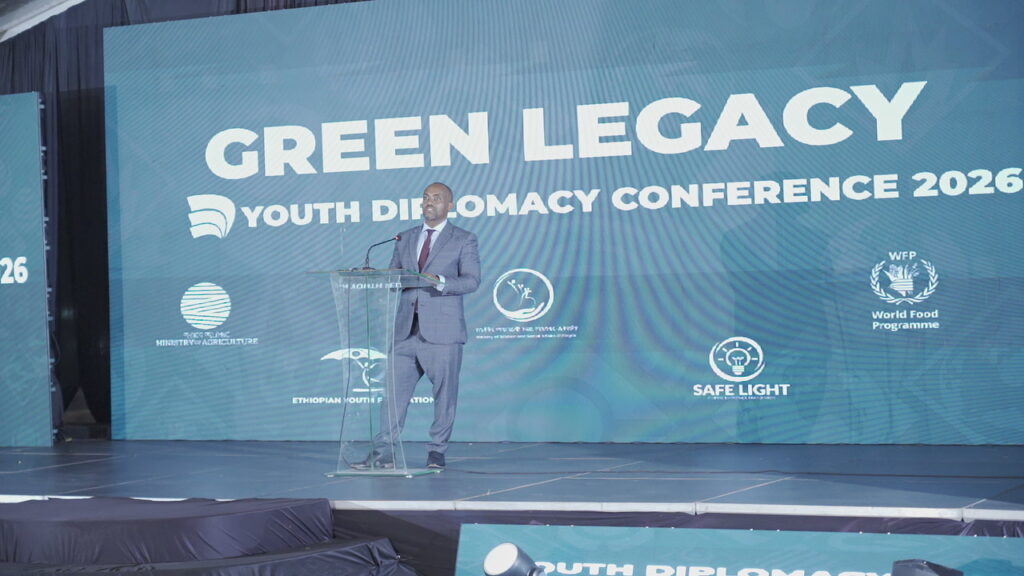
H.E. Temesgen Tiruneh, Deputy Prime Minister of Ethiopia, addresses participants during the LCC 2026 opening ceremony.
“Our Greatest Resource: Our People”
Addressing the gathering, the Deputy Prime Minister emphasized the importance of investing in Ethiopia’s people, particularly its young population.
He described Ethiopia as a nation of resilience, opportunity, and ambition and highlighted efforts to modernize agriculture, expand clean energy, promote innovation, and strengthen the country’s economy.
At the center of this vision, he placed people.
For a youth diplomacy conference, the message carried particular significance: development is not only about infrastructure, policies, or institutions. It also depends on the people who will build, lead, innovate, and serve.

Young delegates and distinguished guests gather during the official opening of LCC 2026.
Agriculture formed one of the strongest themes of the address.
The Deputy Prime Minister described agriculture as fundamental to Ethiopia’s economy, supporting millions of livelihoods and contributing to the country’s future.
He highlighted government efforts in irrigation, mechanization, agricultural research, productivity, and value addition, with the broader goal of strengthening domestic production, rural incomes, and food security.
He also connected food sovereignty with national dignity and national security.
For the young people attending LCC 2026, the message connected directly with the conference theme. Agriculture was not presented simply as a traditional sector, but as an area where innovation, technology, entrepreneurship, and youth leadership can shape the future.
The address then moved from agriculture to environmental sustainability.
The Deputy Prime Minister described Ethiopia’s Green Legacy as more than a tree-planting campaign, presenting it as part of a broader vision for development and environmental stewardship.
He highlighted landscape restoration, watershed rehabilitation, climate-smart agriculture, and investment in hydropower, geothermal, wind, and solar energy.
The central idea was that economic growth and environmental protection do not have to compete with one another.
They can strengthen one another.
This connection lies at the heart of LCC 2026’s focus on sustainable agriculture and green innovation, encouraging young people to consider how development can respond to both economic and environmental challenges.

H.E. Dr. Ergogie Tesfaye, Minister of Women and Social Affairs, and H.E. Addisu Arega, Minister of Agriculture, delivering their opening remarks at the event.
The Deputy Prime Minister also looked beyond Ethiopia’s borders.
With Ethiopia set to host COP32 in 2027, he spoke about the country’s opportunity to contribute to global climate discussions and advance solutions relevant to Africa.
He highlighted climate resilience, sustainable agriculture, renewable energy, and climate finance as important areas for action.
He also emphasized that Africa contributes a relatively small share of global emissions while experiencing some of the most significant consequences of climate change.
For young people preparing to engage in diplomacy, these issues represent an increasingly important part of the international agenda.

Another important part of the speech focused on youth and the economy.
The Deputy Prime Minister highlighted young Ethiopians working in technology, innovation, agriculture, and modern agribusiness, emphasizing the potential of a new generation to contribute to economic transformation.
He spoke of creating conditions in which young Ethiopians can become not only job seekers, but job creators.
He also recognized youth participation in volunteerism, national campaigns, community service, and peaceful conflict resolution.
Together, these examples presented youth leadership as something broader than occupying a formal position.
Leadership can also mean creating opportunities, serving communities, solving problems, and taking responsibility.
Near the conclusion of his address, the Deputy Prime Minister turned his attention directly to the young leaders in the room.
His message was straightforward:
Believe in your ability to make a difference.
He encouraged young people to lead with integrity, courage, and humility, emphasizing that Ethiopia’s future will be shaped by their vision, character, and commitment.
The message also extended beyond Ethiopia. The young delegates were encouraged to see themselves as part of a wider African and global community, with roles to play in diplomacy, sustainable development, climate action, and international cooperation.

The LCC 2026 opening ceremony brought together ideas that are often discussed separately: agriculture, food security, environmental sustainability, renewable energy, youth entrepreneurship, diplomacy, and climate action.
At the center of these conversations was one common question:
What role will young people play in building the future?
The answer offered throughout the opening was not simply that young people are future leaders.
They are already participants in the development process.
Through innovation, entrepreneurship, community service, diplomacy, and leadership, young people have the opportunity to contribute to the challenges facing Ethiopia, Africa, and the wider world.
As LCC 2026 moved forward into its sessions and engagements, the opening ceremony had already established its central message: sustainable development requires not only ambitious ideas, but also young people prepared to turn those ideas into action.
LCC 2026 brings young leaders and distinguished stakeholders together around a shared vision for sustainable development.

The LCC 2026 Diplomatic Dinner created a space for young delegates to engage directly with ambassadors and diplomats, ask meaningful questions, exchange perspectives, and gain practical insights into international relations and diplomatic service.
Beyond formal speeches, these conversations made diplomacy a hands-on learning experience, connecting emerging young leaders with experienced professionals and encouraging dialogue, networking, and cross-cultural understanding.
At LCC 2026, diplomacy was not only discussed from a stage; it was experienced around the table.
